- Resource
- EU Advisory
All you need to know about EU funding

A good soft funding strategy can unleash your potential and help get your idea faster to market, but remember to make sure it’s aligned with your overall strategy and long-term goals.
By Sindre Holme, freelancer and communication consultant in TLSC
Although Norway is not a member of the EU, laws and regulations have been harmonized with the Union in many areas. Norwegian R&D is also closely intertwined with the EU, with Norway a part of the Union's many innovation and funding programs. For companies, academics and other institutions in the life science, health tech and cancer sectors, EU grants are important.
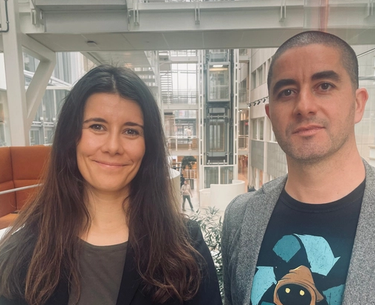
We sat down with EU advisors Sergio Ferreira from Norway Health Tech and Marine Jeanmougin from Oslo Cancer Cluster to dissect the essentials in EU funding. Here’s what we found:
Even though there’s fun in funding, without doing the proper groundwork, applying for EU grants can just as easily be a painful experience, and what EU advisor Sergio Ferreira calls HARDCORE applications (Highly Appreciated but Rejected Despite Continuous Resubmitting).
EU grants are doubtlessly high threshold opportunities, so going into an application process will always be demanding. Remember that there are no shortcuts; the only way to the finish line is through hard, targeted and persistent work, which means what could look like short-cuts are more likely to be short circuits.
However, keep in mind that Norway is punching above its weight and doing better than the average EU country, thanks to the great support available. So even though EU funding application can be daunting, its well worth the effort if you build a strong case and have solid partners in place.
Two basic principles
The different EU instruments are based on two basic principles: market failure and additionality. EU funding to address market failure or sub-optimal investment situation is aimed atniches with high impact or high societal need. Additionality means that EU funding should de-risk projects, crowd in private capital, or make a project happen faster or at a larger scale than the market can do on its own.
Technology readiness levels
There are a lot of soft funding instruments, operating at different stages in a development cycle. They become relevant when a company is entering a certain technology readiness level based on the TRL scale, a measurement of technological or conceptual maturity. The scale goes from 0 to 9, ranging from an idea on paper to something deployed in the real world. Read more about the TRL scale here: https://euraxess.ec.europa.eu/career-development/researchers/manual-scientific-entrepreneurship/major-steps/trl
Planning a great application
How do you navigate the available instruments? It all starts with your strategy, the impact you want to make and how you plan to go from idea to market and hopefully world dominance. These are the steps we suggest you take:
- Define your strategic policy driver: Clarify the societal challenge you are addressing.
- Map out your strategic R&D path: Map out the EU grants as an integral part of your long term strategy,and include private funding and other options in your mapping.
- Stay on the lookout of funding possibilities: Use your network and communityadvisors you to better understand funding possibilities.
- Connect with strategic partners in research and business: most EU funding schemes demand cross-border collaboration with partners in at least three EU or Associated countries (read more about associated countries here: https://eufunds.me/what-are-associated-countries-in-horizon-europe/). Place your solution in the value chain and identify and nurture key partners early on.
- Connect with advisors: Identify the right advisors to help you along with the process (Innovation Norway, The Research Council, Clusters, i.a.)..
- Write a great application: Easier said than done, we know. But try to make your application clear, consistent and attractive.
How the application is evaluated
All proposals are evaluated by a set of criteria: excellence, impact, quality and efficiency of implementation.
Before anyone reads your application, the Commission checks whether you and your project are even allowed to apply , and meet the basic criteria on which the schemes are based. This is the eligibility step.
Excellence means that the proposal must address the objectives and priorities in the call text with a disruptive solution. Furthermore the problem tackled must be well defined, and the approach and methodology sound and innovative.
Impact points to what changes or benefits the project outcomes will create: policy, economic, societal, health, environmental, etc. This criterion is being given more significance, aiming at increasing market and economic development.
Efficiency of implementation boils down to: Is your project the best use of EU funds and are you the best team to carry it out? Is there a credible plan for uptake, exploitation, dissemination, communication and sustainability of results after the funding ends? It’s all about the process
Your application will be evaluated in five steps:
- Step 1. Admissibility and eligibility check.
- Step 2. Individual evaluation by a number of experts (minimum three).
- Step 3. Consensus group: experts discuss to agree on a common standard, including comments and scores for each proposal.
- Step 4. Panel review: The expert panel reaches an agreement on the scores and comments for all proposals within a call, checking consistency across evaluations.
- Step 5. The Commission/Agency reviews the results of the experts’ evaluation and puts together the final ranking list.
EU programs to consider
Here are examples of EU instruments, sorted by TRLs, that are relevant for the health and life science companies. For more information about programs, contact your cluster and we will guide you through the process.
- EIC Pathfinder (TRL 1-3): Taking forward breakthrough deep tech projects with a high degree of scientific and technological ambition and risk and potential to create a new market (TRL 1-4). Read more: https://eic.ec.europa.eu/eic-funding-opportunities/eic-pathfinder_en
- Horizon Europe - RIA (TRL 3-6): Funds research and innovation action (RIA) that establishes new knowledge and/or explores a new or improved technology, product, process, service or solution. Read more: https://research-and-innovation.ec.europa.eu/funding/funding-opportunities/funding-programmes-and-open-calls/horizon-europe_en
- Women Tech EU (TRL 3-6): Grants to support women-led deep tech companies, accompanied by business support services to each grantee. Read more: https://womentecheurope.eu/
- Innovative Health Initiative (TRL 4-7): Funds projects that will address public health needs, improve patients' lives, and boost the competitiveness of Europe's health industries. Read more: https://www.ihi.europa.eu/
- Eurostars (TRL 5-7): Funds Norwegian small and medium-sized enterprises (SMEs) and co-developers that carry out research and development may seek funding for R&D projects. Read more: https://www.forskningsradet.no/en/financing/international-funding/eurostars/
- EIC Accelerator (TRL 6- 9): Funds to develop and scale-up innovations with the potential to create or disrupt markets (TRL 6-8). Read more: https://eic.ec.europa.eu/eic-funding-opportunities/eic-accelerator_en
- Horizon Europe - IA (TRL 6-9): Innovation Actions (IA) fund activities close to market, i.e. later-stage innovation. Typical IA activities (from the official definition) are prototyping, testing, demonstration, piloting, large-scale product validation and market replication. Read more: https://research-and-innovation.ec.europa.eu/funding/funding-opportunities/funding-programmes-and-open-calls/horizon-europe_en