- Success story
Norwegian experience with digital monitoring sparks interest in Sweden

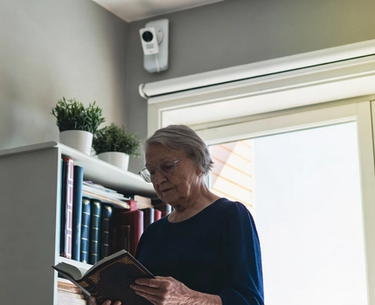
Research-based insight from Norwegian municipalities is becoming an export product to a Swedish market facing many of the same challenges. Through Norway Health Tech's network, Tellu and Vitec Appva were brought closer together. Now, the findings from the Nullpunkt '26 study are forming the basis for a new collaboration on how municipalities can succeed in introducing digital monitoring and other welfare technology.


Written by
Therese Oppegaard
📸Tellu
How does one actually succeed in introducing new technology in health and care services? Why do some municipalities achieve clear gains, while others get far more limited results from solutions that are, in principle, fairly similar?
These are the questions Tellu has explored in the study Nullpunkt '26, which looks closely at the use of digital monitoring in institutions and care housing. The study follows the introduction of digital monitoring from before start-up, through implementation, and onward into ordinary operations. The goal has been to understand what actually happens when digital monitoring is put into practice. It is this insight that has now sparked interest in Sweden.
Connected through the cluster
Through Norway Health Tech's resource group for Sweden, Tellu entered into closer dialogue with Vitec Appva, a Swedish provider that delivers digital solutions for task and medication management to a large share of Swedish municipalities.
In the dialogue, the two companies quickly discovered that they complement each other well. Tellu has built up considerable experience with digital monitoring and implementation in Norwegian municipalities, while Vitec Appva holds a strong position in the Swedish municipal market through its task and medication management solutions.
– We already knew about Vitec Appva, but through Norway Health Tech we got an arena that made it easier to build the relationship further. That's where the dialogue became concrete, and we started exploring what possibilities a collaboration could hold, says Kristian Renaas, Commercial Director at Tellu.
He explains that Vitec Appva is interested in the experience Tellu has built up through its work with digital monitoring and implementation.
– We have long experience from Sweden, while Tellu has developed valuable expertise in Norway, says Ulrika Bergström of Vitec Appva.
– We work in different areas, but our solutions overlap and complement each other. Together, data from our services can provide a better basis for understanding users' needs and planning services, she adds. Bergström confirms that participation in the cluster has helped strengthen the contact between the companies.
Benefits don't come by themselves
Many technology projects start without the municipality having mapped out well enough how the service functions before the solution is introduced. That makes it difficult to know what the technology has actually contributed, and whether the gains can be documented at all.
That is why Tellu has placed strong emphasis on mapping the starting point in the Nullpunkt '26 study. The study examines how services operate before the introduction of digital monitoring, and how the situation develops after the technology is put into use.
– Many suppliers talk about what the technology can do. Nullpunkt '26 points more to what needs to be in place for the technology to actually deliver value, says Linda Cecilie Grøndal-Eeles in Tellu.
For Grøndal-Eeles, one finding from the study stands out in particular: municipalities need to understand their starting point before they begin.
– Through the baseline mapping, we gained insight into how the services actually worked and where the potential for improvement lay, she adds.

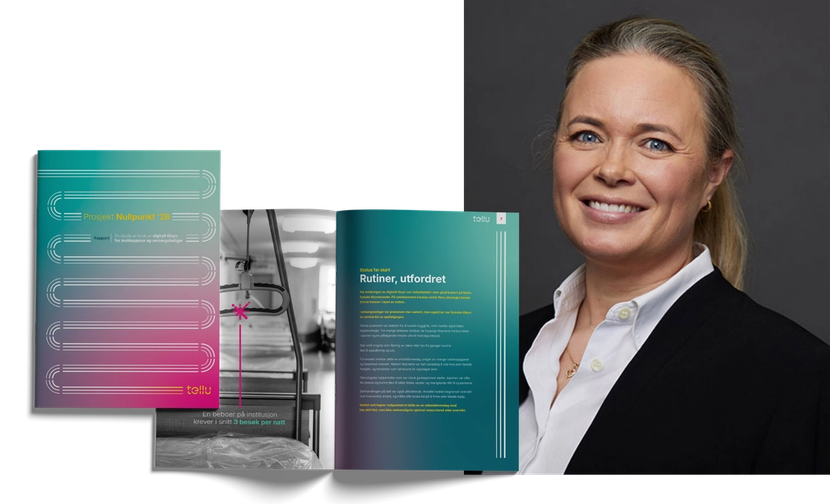
Linda Cecilie Grøndal-Eeles is a researcher, advisor on health technology at the Norwegian Directorate of Health, and Principal Advisor for Health Insights and Regulatory Affairs at Tellu. 📸Tellu
The report shows that the effect of new technology largely depends on how it is put into use. Implementation doesn't stop once the solution is installed. Working methods must be adjusted along the way, and the technology must be adapted to the needs of the service. In the early stages, new solutions can create uncertainty and a need for adjustments. It is only once staff have gained experience with the technology and routines have settled that the gains can be fully realized.
– I hope decision-makers come away understanding that technology alone doesn't create change. The greatest gains come when municipalities combine technology with good implementation and clear leadership, says Grøndal-Eeles.
She stresses that gains are rarely visible from day one.
– The implementation phase can be demanding, and results don't necessarily appear right away. When services are given time to adjust course along the way, the effect often becomes far clearer.
From knowledge-sharing to collaboration
The Nordic region is a priority market for Norway Health Tech. Through the project Nordic Health Connect, funded by Akershus County Council, the cluster brings together members from across the Nordics in resource groups and meeting places, with the aim of creating cross-border collaboration. The partnership between Tellu and Vitec Appva is a concrete result of this work. For Tellu, the dialogue with Vitec Appva has opened the door to new contacts in Sweden. For Vitec Appva, the collaboration gives access to experience and insight relevant to their municipal customers.
– This collaboration is a really good example of what we want to achieve in these resource groups," says Lucie Meltzer in Norway Health Tech.
– Globally speaking, Norway and the Nordics are relatively small, so when suppliers find areas to collaborate on, it strengthens their competitiveness internationally, she adds.
On September 9th, Tellu and Vitec Appva invite you to a joint webinar on implementation and value realization. Here, the findings from the Nullpunkt '26 study will be shared with both Norwegian and Swedish municipalities.
Download the Nullpunkt 26' report