- News article
Reliable technology is essential for mobile care

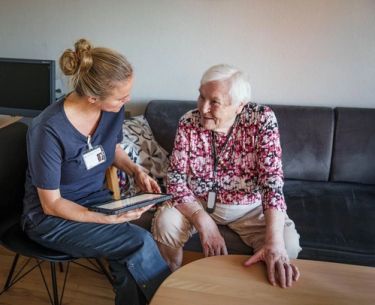
More health and care services are being delivered closer to where people live, and healthcare professionals need access to up-to-date information and documentation while on the move. In Denmark, municipalities have made significant progress in adopting mobile tools for healthcare professionals. Their experience offers valuable lessons for Norwegian municipalities, particularly when connectivity fails.


Written by
Therese Oppegaard
📸Systematic
When documentation is completed in the patient’s home, healthcare professionals no longer need to return to the office to enter information, and patient records can be updated closer to the point of care. The reliance on technology does not disappear, however. Instead, it shifts to mobile coverage, wireless networks, identity and access solutions, and mobile devices. A basement with no signal can be enough to bring a system that works perfectly well in the office to a halt. Such disruptions are part of everyday working life, and a mobile solution needs to allow healthcare professionals to continue working when they occur.
There is also a difference between accessing information and documenting care. If a critical action cannot be recorded, the next member of staff may lack the information needed to provide appropriate follow-up care. And if the municipality’s login service goes down, the electronic health record becomes inaccessible even if the system itself is technically operational.
Standards and requirements in Denmark
Denmark’s approach is built on common standards. Fælles Sprog III is the common municipal standard for documentation and data in healthcare and elderly care, providing shared terminology and classifications. Denmark’s Elderly Care Act, which entered into force on 1 July 2025, introduces helhedspleje, an integrated approach in which different services are viewed as part of a coherent care pathway. As part of the implementation of the Act, documentation is linked to Fælles Sprog III.
Denmark’s NIS2 Act entered into force on the same date and sets requirements for risk management and incident reporting. Municipalities are covered by the legislation, and KL stresses that senior management must carry out its own risk assessments for critical public services. In health and care services, security also means ensuring that the right healthcare professional can access the system when information is needed.
From 1 January 2026, sundhed.dk, the Danish Health Data Authority and MedCom were brought under joint management as part of the preparations for Digital Health Denmark. The organisation will be formally established on 1 January 2027 and will be jointly owned by the state, regions and municipalities.
Building resilience into mobile care
In the Columna Cura care record system, relevant data is synchronised to the healthcare professional’s mobile device. If connectivity is lost while visiting a patient, work and documentation can continue, and the information is transmitted once the connection is restored. If the central system is unavailable, a separate emergency record provides access to essential information.
According to Systematic, the solution has been developed and validated in collaboration with 27 Danish municipalities.
– We have designed the solution from a preparedness perspective, with a strong focus on resilience in the event of a loss of mobile connectivity, says Tonje Heyn of Systematic Norway.
The company now wants to bring its experience from Denmark into the Norwegian health and care sector.


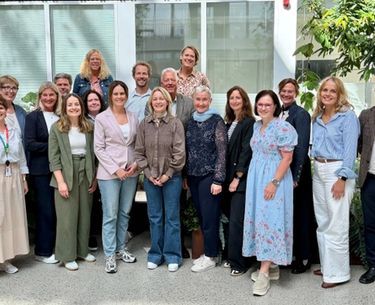
Tonje Teigene Heyn of Systematic AS is confident that the lessons learned from Denmark’s municipal sector are equally relevant to Norwegian municipalities. 📸Systematic
Eight points Norwegian municipalities should consider
Experience from Denmark shows that resilient digitalisation is about more than technology. Municipalities also need to understand the dependencies that arise, which functions are critical, and how services should operate when parts of the digital infrastructure fail.
- Mobility shifts dependencies. Documenting care in the patient’s home reduces office-based work, but makes services dependent on mobile coverage, wireless networks and mobile devices. These dependencies should be mapped before mobile working practices are introduced on a large scale.
- Offline working is part of everyday life. Basements with no mobile coverage and unstable networks inside buildings are common challenges. Offline functionality needs to be built into the solution from the outset.
- Availability is part of security. The right healthcare professional needs access when information is required. This should be reflected in the municipality’s security requirements, not treated solely as an IT operations issue.
- Define the required level of preparedness in advance. Disruptions are rarely all or nothing. Municipalities should determine which functions are critical, what reduced level of service is acceptable, and who has the authority to activate contingency solutions.
- Reading is not the same as documenting. Access to patient records is important, but municipalities also need to determine which actions must be documented while the main system is unavailable. If a critical action is not recorded, the next healthcare professional may lack essential information.
- Login can be just as critical as the patient record itself. Contingency planning needs to cover the entire chain, from identifying the user to granting access to the system.
- Control and resilience are not the same thing. A locally hosted solution may offer greater control, but can still be vulnerable if the municipality’s own infrastructure is affected. A cloud-based solution may be more resilient to local outages, but creates other dependencies. The key is to understand those dependencies and make informed choices.
- Preparedness needs to be practised. A contingency solution has little value if no one knows when to activate it, who makes that decision or how work should continue. Technology needs to be supported by clear responsibilities and regular exercises.
This article was produced by Norway Health Tech in collaboration with Systematic, with expert input from, among others, Tomas Stæhr Berg, Lead Architect, and Christina Zakrisson, Product Management.
Sources
- Fælles Sprog III, KL: kl.dk
- Danish Elderly Care Act, in force from 1 July 2025, KL: kl.dk
- Digital Health Denmark, Danish Health Data Authority: sundhedsdatastyrelsen.dk
- Act on Digital Health Denmark: retsinformation.dk
- NIS2 and municipalities, KL: videncenter.kl.dk
- NIS2, Danish Agency for Societal Security: samsik.dk
- Digitalisation in health and elderly care, KL: kl.dk